Ron Garcia
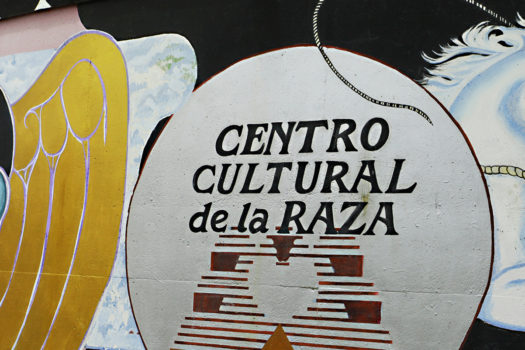
La Prensa San Diego – “Seven Year Boycott of San Diego’s Centro Cultural de la Raza Ends”
by La Prensa Editor, Report on the end of the historic boycott on the Centro, 2007:
The seven-year-old boycott of the Centro Cultural de la Raza, San Diego’s historic Chicano/a community arts center, has ended after the adoption by popular vote of a comprehensive and dynamic boycott resolution agreement.
The Save Our Centro Coalition, initiators of the boycott, announced the end of the boycott on April 21 at the 37th annual Chicano Park Day celebration in Barrio Logan. The announcement came after 18 months of negotiations between representatives of the Centro’s Board of Trustees and the Save Our Centro Coalition.
As a result of the negotiations, which were mediated by a team from the National Conflict Resolution Center, a boycott resolution agreement was adopted which guaranteed the addition of SOCC members to the Centro Board, re-established the Centro’s Arts Advisory Committee, created a Community Advisory Council and enacted several new policies to address perceived conflict of interest issues and to stimulate transparency and community participation in the Centro.
http://www.laprensa-sandiego.org/archieve/2007/may11-07/centro.htm
Details
San Diego CityBeat – “The Knitters”
by Vi White, A profile of my knitting group, 2006:
When one of the oldest of old-school trends reared its warm and woolly head in 2000, no one was ready for the swarms of hot urban goddesses, tatted arms swinging and tattered Pumas, Fluevogs and Chucks keepin’ rhythm to the clicks of the needles, the sway of the conversation and the chill indie noise.
Whether it’s a take-it-back feminist bent, a throwback to what your foremothers taught ya, or just a way to keep your fingers busy and your neck warm, knitting groups have popped up across urban landscapes in almost every shape and form. So what else is there for these quietly creative, urban trendistas to do but pick up some yarn and get to it?
http://sdcitybeat.com/culture/art-culturethe-knitters/
Details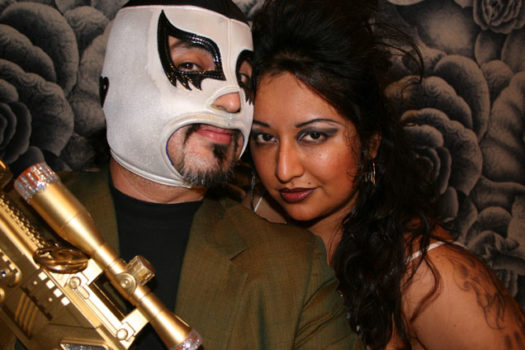
La Prensa San Diego – “Luchador Poetry, Paintings & Piledrivers in Balboa Park”
by Michael Klam, A report on the “Rudos y Technicos” show at the Museum of the Living Artist, 2006:
In wrestling, as in life, you can be a rudo or a técnico… and sometimes both. A técnico is the good guy who plays by the rules, sort of like the shimmering, spur-jingling cowboy in the white hat.
And the rudo does not play fair. He can be the underhanded evildoer. He cheats and is both hated and loved for his devilish deeds: Try to imagine something like fellow luchadores, The Flea and Dr. Terrifico, employing the “Super Rudo Under the Cheek Sneak” move, which makes a POOT noise in your spine!
http://www.laprensa-sandiego.org/archieve/2006/august11-06/luchador.htm
Details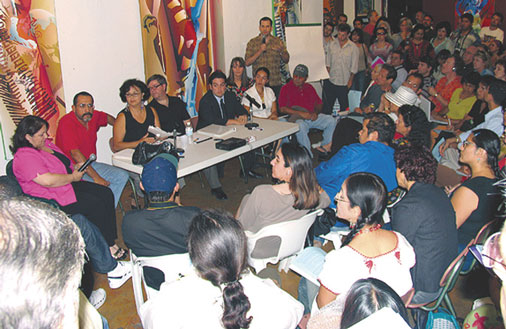
La Prensa San Diego – “The Self-Help Graphics Crisis”
by Sandra Pena-Sarmiento, A report comparing cultural center dysfunction in Los Angeles and San Diego, 2005:
Early Rumblings
The warning signs began early, slowly trickling in while I was Director of Programming for the 2004 San Diego Latino Film Festival. I had set up a deal to license the artwork of Los Angeles based artist/activist Alfredo de Batuc for the 2005 Festival. In March of 2005, while the festival was in full swing, De Batuc came down to promote his work. I showed him the local sights: the murals at Chicano Park, Chicano Perk Café and Adams Ave. We spoke of community art spaces, in particular, the situation at San Diego’s Centro Cultural de La Raza.
Five years after a new administration employed draconian measures that resulted in a rift between the Centro and the local community, the organization was largely absent from the local art scene. Both Alfredo and I had visited the site in its heyday, and we lamented its spiral downward.
De Batuc spoke of the problems of many organizations throughout the nation, all started 30+ years before, and facing the challenge of maintaining their viability without choking off the vision of its participating artists. Without the artists, the centers had no creative resources to fundraise with, no stellar shows to publicize, no audience base of adoring art patrons to provide a revenue base. He began to tell me about similar problems at Self-Help Graphics, that started after its founder, Sister Karen passed away. Her assistant, Tomas Benitez became the new Executive Director, even though it was not a title he had actively sought out. The role of ED at any institution in this age of budget cuts and lack of federal funding, was certainly a heavy one to bear.
http://www.laprensa-sandiego.org/archieve/july08-05/graphics.htm
Community comes together for the Self-Help Graphics. Photo by Harry Gamboa Jr.
Details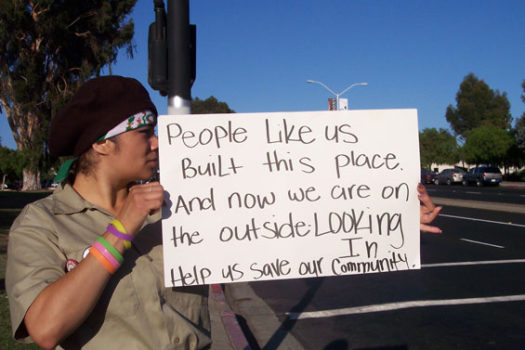
La Prensa San Diego – “The Struggle Continues…”
by Pablo Jaime Sainz, Report on the SOCC Boycott on the Centro Cultural de LA Raza, 2005:
After three months of not doing any demonstrations as part of a truce, the Save Our Centro Coalition (SOCC) held a protest last Thursday September 8 outside the Centro Cultural de la Raza, in Balboa Park.
The reason? The Centro’s board hadn’t shown any sign of continuing the dialogue, according to Sandra Peña Sarmiento, SOCC’s member and organizer.
“When we cooperate and promise not to put any pressure, nothing happens,” she said. “The Centro’s board stops every effort for dialogue.”
http://www.laprensa-sandiego.org/archieve/september16-05/centro.htm
Details
OC Weekly – “Attack of the Pochos”
” by Gustavo Arellano, Profile of my gallery inside the Santora Arts Building next to the Artists Village Promenade, 2003:
Tenaya HillsSandra Sarmiento heard the epithet whispered constantly after she returned to Santa Ana from Chapman University during the early 1990s: pocha.
“When I got home from college, everyone could tell my accent and mannerisms were changing from Mexican to more American. Soon, a chorus of ‘pocha‘ began greeting me everywhere I went,” the half-Mexican, half-Bolivian beauty remembers over a bowl of bún in Little Saigon. “I would be walking down the street and hear people yelling from their cars ‘¡Pocha!‘ One time, I was at El Toro Meat Market and when I asked for a price check, they announced ‘We need a price for this pocha!’ Over the store’s PA system!”
https://www.ocweekly.com/attack-of-the-pochos-6401136/
Details
Cal State LA – “East of the River”
curated by Chon Noriega, Art Show notice in Los Angeles, 2000:
Avant-garde film and video shorts
7:00 p.m. at the Maxwell Theater, University-Student Union, Cal State L.A.
Chicano Visions is a series of ground-breaking film and video shorts by Chicano filmmakers and visual artists, representing four strands of Chicano experimental work since the early 1980s: conceptual dramas, testimonios, postmodern explorations of media, and domestic and border cultures. Included are works by Danny Acosta, Laura Aguilar, Frances Salome Espana, Harry Gamboa Jr., Juan Garza, Berta Jottar, Ana Machado, Pocha Pena, and Willie Varela. The program will be introduced with words from program curator, Chon Noriega (Associate Professor, Critical Studies Program, Department of Film and Television, UCLA). Sponsored by the L.A. Freewaves 7th Celebration of Experimental Media Arts throughout Los Angeles County during the month of November.
http://www.calstatela.edu/univ/ppa/newsrel/chicanopr.htm
Details
“Shot in America” book by Chon Noriega
– “The Pocha Manifesto” by Pocha Peña, A manifesto about the place of women of color in TV & Cinema, 2000:
One of the most influential figures in ethnic media studies takes direct aim at how Chicano filmmaking has been represented in the history of media in the United States. Shot in America tackles seemingly intractable dilemmas involving the political and market functions of film and TV to provide a definitive response to the debates over cultural and racial identity that have embroiled media and cultural studies over the past two decades.
Details
US Latinos and the Media: Theory and Practice
by Chon A. Noriega, Guest Editor
from Jump Cut, no. 39, June 1994, pp. 57-58
copyright Jump Cut: A Review of Contemporary Media, 1994, 2006
Finally, in “Pocha Manifesto #1,” Sandra Peña-Sarmiento reclaims and redefines the Mexican derogation pocha as the socio-aesthetic principle for a new generation of Chicana filmmakers, artists and writers. Interestingly, at about the same time that Peña-Sarmiento started producing video art under the banner of Pocha Productions, Chicano Secret Service, a comedy group comprised of three recent UC-Berkeley graduates, began to self-publish Pocho Magazine, an irreverent send up of both Chicano and mainstream cultures. In 1993, the group conducted an elaborate media hoax, promoting a State of the Pocho (STOP) Summit hosted by the National Pochismo Institute (NPI). The announcement appeared in Hispanic Magazine, among other places.[3] In her manifesto, Peña-Sarmiento identifies the cultural and gender biases that operate within both the Chicano community and the national culture.
https://www.ejumpcut.org/archive/onlinessays/JC39folder/Latinos2Intro.html
Details